Guide · Choose by light
Blackout, Room Darkening, Light Filtering or Sheer?
Curtains are sold by how much daylight they let through. Every Lights Out pack shows four steps, from the most light to the least: sheer and light filtering, room darkening, blackout and 100% blackout. Start with the room and what you do in it, then pick the step.
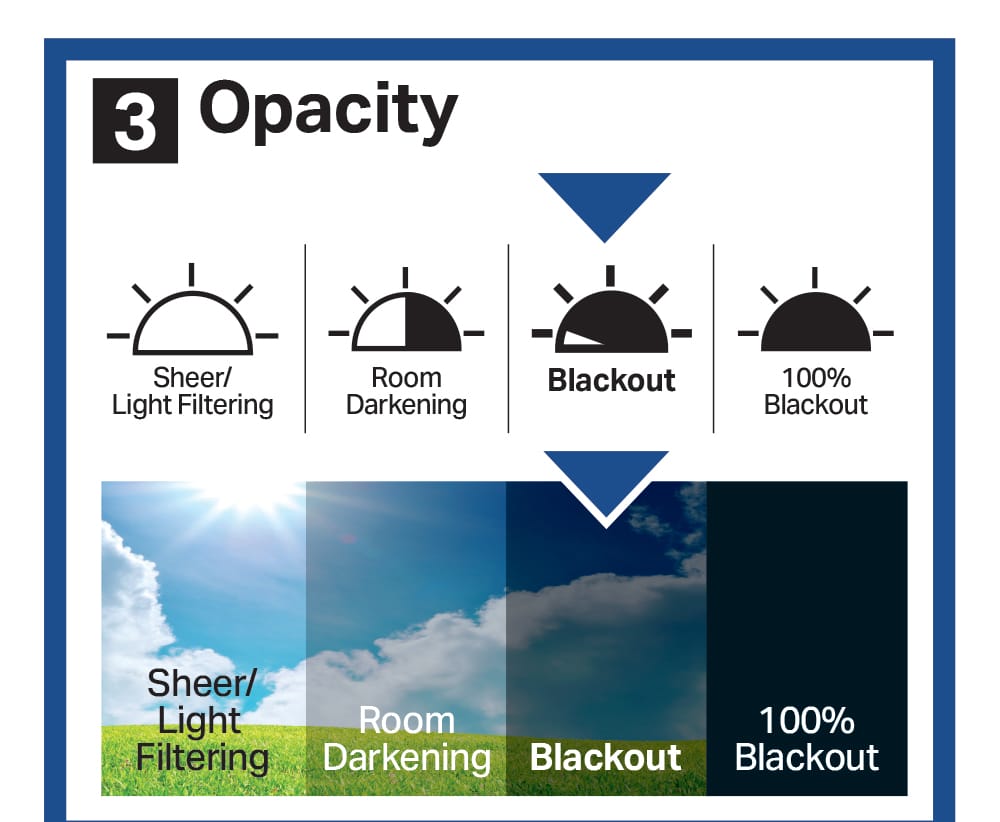
The four steps at a glance
| Step | What it does | Often chosen for |
|---|---|---|
| 1 · Sheer and light filtering | Softens the daylight and keeps the room bright. You see light, and shapes, through it. | Living rooms, dining rooms, kitchens; under a heavier curtain |
| 2 · Room darkening | Dims the room and gives you privacy. Some light still comes through the fabric. | Living rooms and bedrooms that need privacy more than full dark |
| 3 · Blackout | Makes the room dark, for sleeping in or for a screen. | Bedrooms, nurseries, TV rooms |
| 4 · 100% Blackout | The darkest step, as The Home Depot names the type. | Bedrooms and media rooms, day sleepers, east-facing rooms |
Sheer vs light filtering
Both let the day in. A sheer is fine and see-through, like a voile: the lightest step. A light filtering curtain is a denser weave, a jacquard or a linen blend, that blurs the view and still keeps the room bright. Neither is meant to darken a room; for privacy at night, hang one in front of a darker curtain or a blind.
Lights Out sheers: Voile, Sasha, Pleated Stripe, Leaf Embroidery. Light filtering: Valencia, Orion, Luna Lattice, Carmel Leaves, Dover, Blooming, Ticking Stripe.
Room darkening vs blackout
This is the choice most people are making. Room darkening dims a room and gives privacy, but the room is not dark at noon. Blackout is the step to choose when the point is a dark room: sleeping after sunrise, a nap in the afternoon, a screen on a sunny day.
- Choose room darkeningfor a living room or a guest room where you want privacy and softer light, and still want to see the time of day.
- Choose blackoutfor a bedroom, a nursery or a TV room, where you want the room dark when the curtains are closed.
Room darkening: Chelsea, Morgan, Camilla, and in stores Savoy and Summit. Blackout: Alona, Hayden, Alona Lattice, Alona Leaves, Golden Leaves, Marquee.
Blackout vs 100% blackout
Both are made for a dark room. 100% Blackout is the darkest step on the Lights Out scale and the name The Home Depot gives the type; choose it for the room where any light bothers you. The plain blackout styles add embroidery, foil and a softer hand.
100% Blackout: Paloma, Fairfax, Trellis, Beekman Magnet Closure, Contractor Set.
Light comes in around the edges
Even the darkest curtain lets light in where it ends: past the sides of the window, over the rod and under the hem. How you hang it matters as much as the fabric.
- Go wider. Mount the rod past the window frame on both sides, so closed panels overlap the wall.
- Go higher. Mount the rod above the frame, so light does not spill over the top.
- Go longer. A floor-length panel leaves no gap under the sill. See how to measure for curtains for widths and lengths.
- Close the middle. Use enough panels that they meet with fullness, not stretched flat. Beekman has magnets sewn into the middle edges so the two halves close together.
Layering: two steps on one window
On a double rod, hang a sheer or light filtering curtain in front of the window and a blackout or room darkening one behind it, or the other way round for the look you want from the room. Open the dark layer in the day and keep the soft one closed; close both at night.
Pick by room
- BedroomBlackout or 100% blackout, floor length, rod mounted high and wide.
- NurseryBlackout, so the room can be dark for daytime naps.
- Living roomRoom darkening for privacy, or a light filtering curtain layered with a darker one.
- TV or media roomBlackout or 100% blackout.
- Kitchen and dining roomSheer or light filtering, to keep the room bright.
Next: measure for curtains, or see all styles by light level.